What Is Telemetry? How Live Data Gets Home
What telemetry actually is: how sensor readings are sampled, framed, sent over a link and decoded, from rockets and race cars to the bench in front of you.

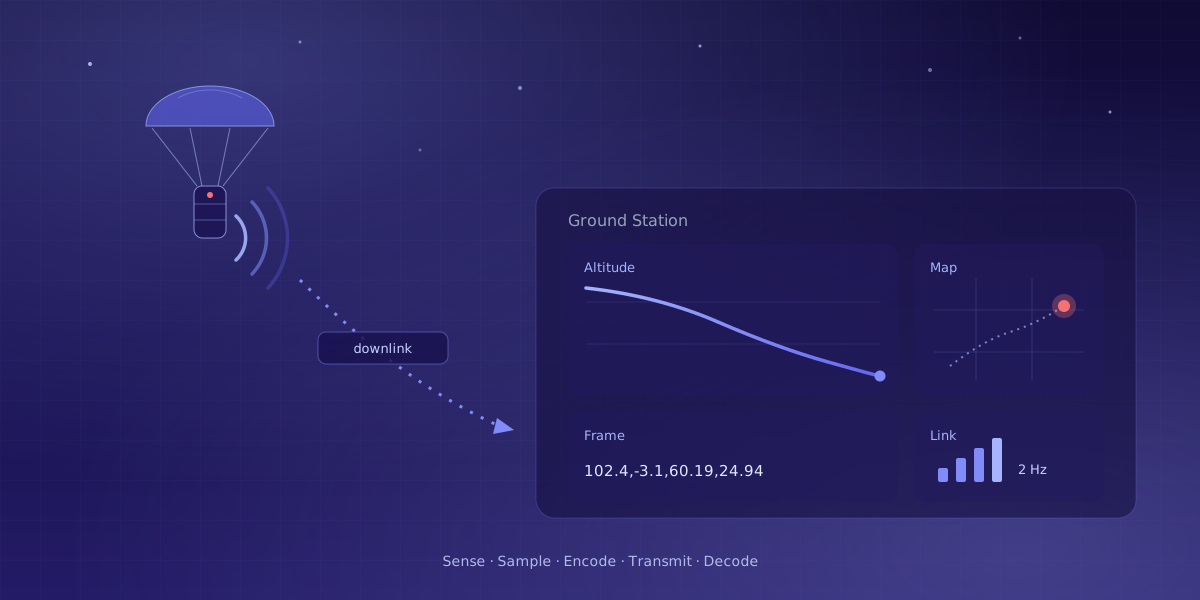
Telemetry is measurement at a distance. The word says exactly that: tele, far, and metron, measure. A rocket cannot pull over so an engineer can read a pressure gauge, a race car cannot stop mid-lap to have its tire temperatures checked, and a weather balloon is not coming back in any useful condition. Telemetry is the discipline of getting the measurement to come to you.
That sounds grander than it is. If you have ever watched an Arduino print sensor values into a serial monitor, you have run a telemetry link. The distance was a meter of USB cable, but every piece of the real thing was present. What changes between your desk and a launch pad is scale, not kind.
The chain every telemetry system shares
Strip away the domain and every telemetry system is the same five steps.
Sense. A physical quantity meets a transducer: a thermistor, a pressure sensor, an accelerometer, a GPS receiver. The output is an electrical value standing in for a physical one.
Sample. The system reads that value at some rate. Choosing the rate is a real decision: a battery voltage might need one sample a second, vibration analysis might need thousands. Sampling too slowly does not just blur a signal, it can alias a fast one into a convincing slow lie.
Encode. Readings become bytes. Human-readable text like a line of comma-separated values is simple and debuggable; packed binary is smaller and faster. Either way, the readings are arranged into a frame: one self-contained unit of "here is a complete set of measurements," often with a marker or checksum so the receiver can tell where a frame starts and whether it survived the trip.
Transmit. The frame crosses a link. The link is whatever the situation allows: a wire, a UART over USB, a Wi-Fi socket, a LoRa or cellular radio, a satellite pass. Every link has a budget, in bits per second and sometimes in dollars, and the budget decides what you can afford to send. This is why real systems send raw counts instead of formatted text, and why choosing what not to transmit is half the job.
Decode and display. The receiving end reverses it all: find the frames, extract the values, convert counts into engineering units, and put the result in front of a person as plots and gauges, and into a file for the analysis that happens after. The receiving end of a telemetry system has a name you have probably heard: the ground station. One useful distinction rides on top: data flowing from the vehicle to you is telemetry, or the downlink; commands flowing the other way are telecommand, the uplink. They usually share the link but they are different problems, and plenty of systems get by with downlink only.
What the link will physically allow
The transmit step deserves a longer look, because the "budget" it mentioned is not a product decision, it is physics, and one formula governs all of it. Claude Shannon proved in 1948 that a channel has a hard capacity ceiling set by just two things: how much bandwidth it occupies and how far the signal stands above the noise. More bits per second require more bandwidth, a stronger signal, or both, and no cleverness in the encoding step ever beats the ceiling. This is the actual reason your USB cable moves megabits without effort while a deep-space probe cannot: the cable's signal is enormous compared to its noise, and the probe's is barely there. Radio power spreads over an ever-larger sphere as it travels, so doubling the distance alone cuts the received power to a quarter. Follow that law far enough and you reach Voyager 1, whose routine telemetry now trickles home at 160 bits per second, slower than a teletype, from hardware that works perfectly. The link is weak because the signal is faint, and the signal is faint because physics says so.
The same physics decides how a link fails, and the answer is quietly: a marginal radio link does not stop, it lies occasionally. Noise flips individual bits at some rate, called the bit-error rate, and small-sounding rates compound. At one flipped bit per hundred thousand, a hundred-byte frame arrives corrupted roughly once every 125 frames, a few times a minute at typical rates, each corruption a plausible wrong number rather than an obvious blank. This is why checksums are not optional on radio links, and why systems that cannot ask for a resend, and a probe hours away by light certainly cannot, spend a large fraction of their precious bits on error-correcting codes: deliberate redundancy that lets the receiver repair flipped bits instead of merely detecting them. Choosing what to spend the channel on, payload versus protection, is link design in one sentence. Distance shapes the choice of link in one more way. A direct radio link is limited by the horizon: the higher the antenna, the farther it sees, which is why a weather balloon at altitude can reach ground stations hundreds of kilometers away while two ground-level radios lose each other past a few. When line of sight runs out, the modern workaround is to ride the cellular network, which trades the horizon problem for new costs: latency through a provider's infrastructure, coverage you do not control, and a middleman between you and your own measurement. Neither option is wrong; they are different answers to the same constraint, and recognizing which constraint you are paying for is most of choosing a telemetry radio.
The details that bite
Three of the five steps hide the classic telemetry problems.
Units. The wire carries counts, so someone must own the conversion to volts and degrees, and doing it at the ground station means a calibration fix never requires touching the vehicle (this is exactly what dataset transforms are for).
Timing. If frames arrive in bursts, arrival time is not measurement time, and honest plotting needs the timestamp treated as data.
Loss. Links drop bytes, so frames need boundaries and checksums, which is why framing exists at all.
These three are not edge cases; most of the lessons production firmware teaches about telemetry are these same problems, met in the field.
You already have telemetry around you
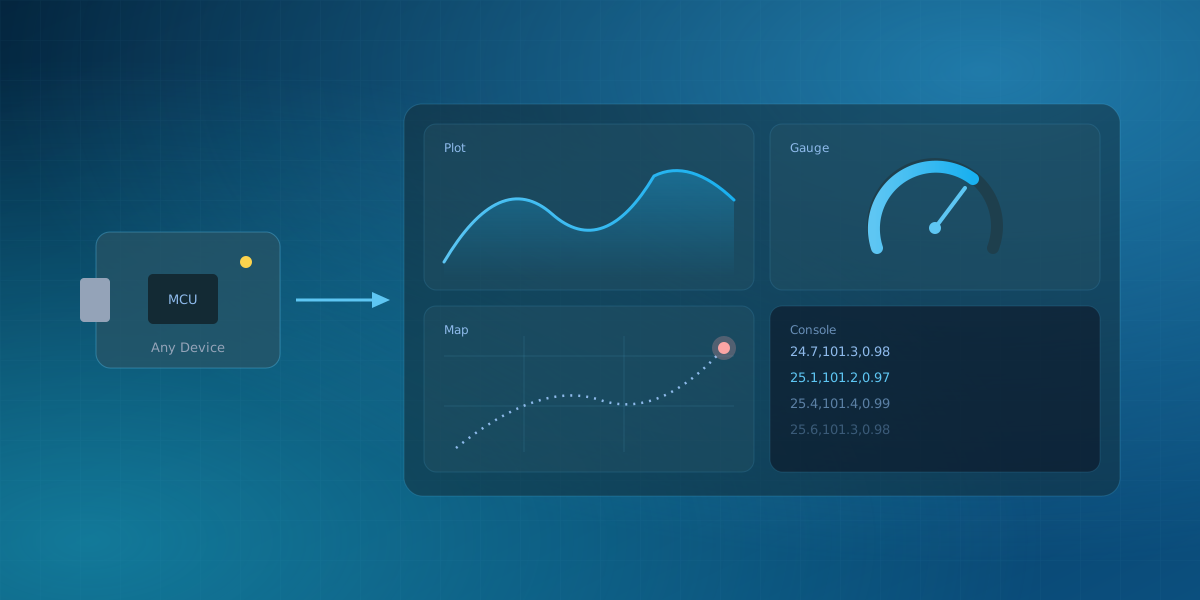
A modern car is a telemetry network on wheels: dozens of modules broadcasting measurements on the CAN bus, which is how a scan tool can read them. A factory floor polls its sensors and drives over Modbus. An IoT deployment publishes readings through an MQTT broker, often from something as small as an ESP32 sending sensor data over Wi-Fi. A student CanSat dropping from altitude radios its pressure and GPS fix down at a few hertz. Different links, different protocols, one chain. And the bench version remains the most common of all: a microcontroller, a sensor, and a stream of values you want to see move. The ground station for that scale is just software on your laptop. Serial Studio is one, built around exactly the chain described here: it reads the link, finds the frames, decodes the values, converts the units, and gives you the live dashboard and the recording. The getting-started guide turns a printed line of numbers into one in a few minutes.
Frequently asked questions
Is telemetry always wireless?
No. The measure of telemetry is remoteness, not radio. Power plants ran wired telemetry over phone lines decades before anything flew, and a USB cable to a microcontroller is a wired telemetry link. Wireless just raises the stakes: less bandwidth, more loss, no second chances.
What is the difference between telemetry and data acquisition?
Mostly emphasis. Data acquisition (DAQ) stresses the measuring itself, often at high precision with the instrument next to you; telemetry stresses moving the measurement across a link you do not fully control. A vibration test rig on your bench is DAQ; the same sensors on a vehicle you cannot walk up to are telemetry. The tooling overlaps almost completely.
Why does my software's privacy policy mention "telemetry"?
The software industry borrowed the word. There, telemetry means usage and diagnostic data a program sends back to its maker, which is remote measurement too, just of you. It is the same word for an unrelated conversation; this post is about the engineering kind. (For the record, Serial Studio collects none of the software kind.)
What does a telemetry frame look like?
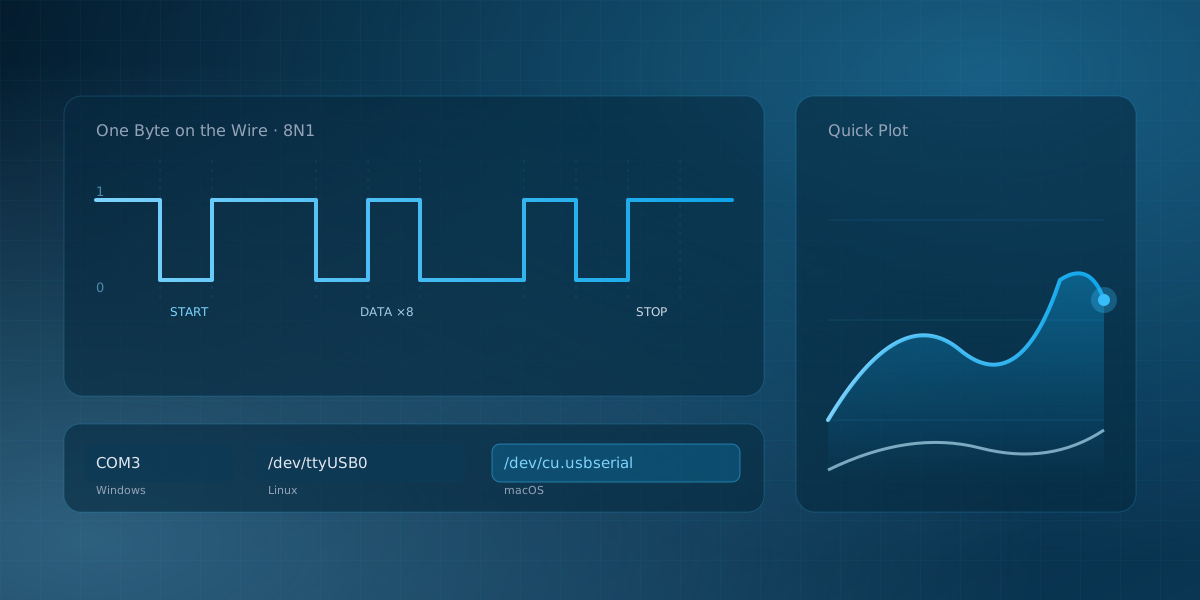
Whatever the designer chose, which is the honest answer and the reason decoding is configurable. The simplest real frame is a line of text: comma-separated values ended by a newline, where the newline is the frame boundary. Binary systems use a start marker, a fixed or length-prefixed layout, and a checksum. Established formats like MAVLink or NMEA are exactly this, standardized.
Comments